Mined,
not minted.
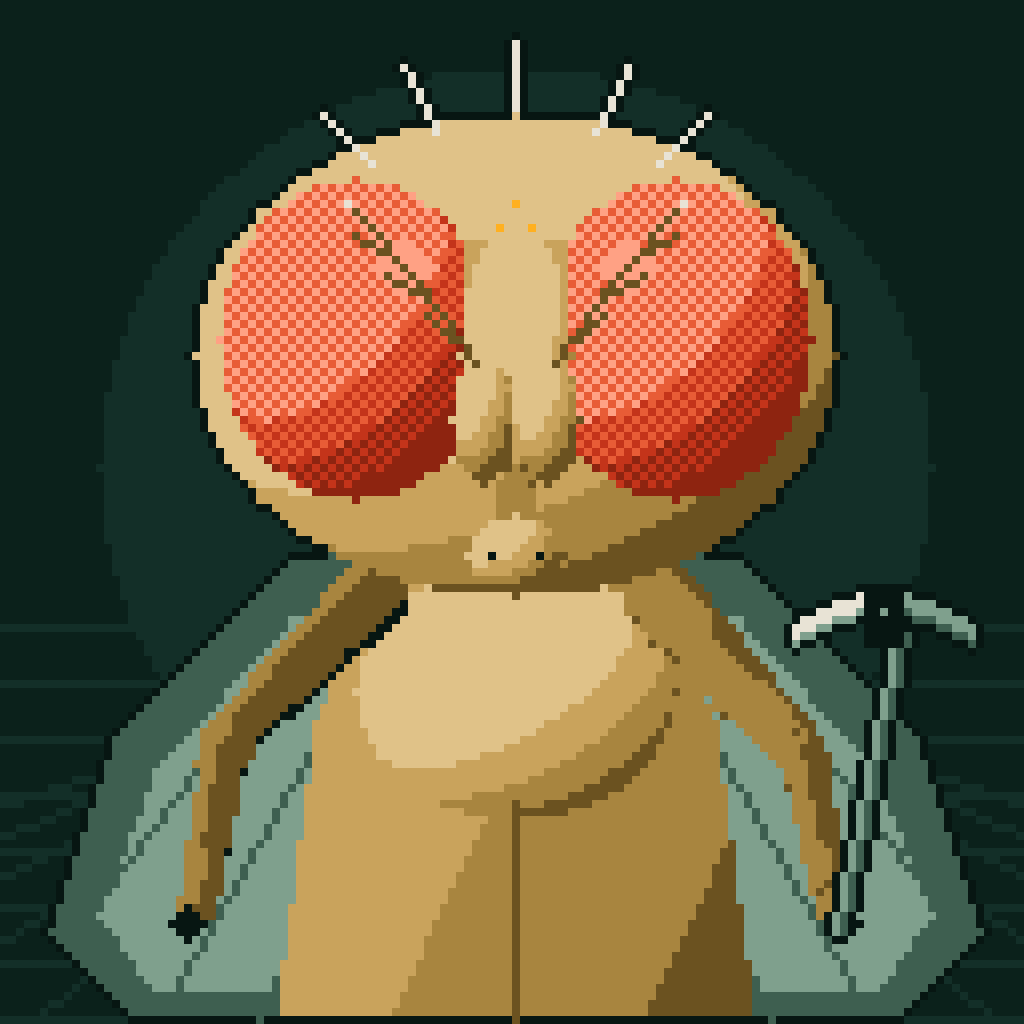
Pixel flies that live inside one contract. No allowlist and no supply cap: your browser hunts for a hash below the network target, you pay the entry price of the current epoch, and the contract draws the fly from it — wings, eyes, the thing in its grip, forever.
 SEED → FLY
Pre‑launch. Mining opens when the contracts are deployed and verified on Arc. No mining date is claimed until then.
Nine slots picked from 126 traits by the seed of each fly. These examples show the artwork, not live minted NFTs. Click any fly to open its traits.
Three steps, none of them ours
Nothing here waits on a server, a signature, or a list. The whole path from electricity to fly runs between your browser and one contract.
Your browser hashes four things: your address, a nonce, the work behind the last fly and a recent block. Nobody can steal the answer — your address is inside it; nobody can prepare one in advance — the previous fly is inside it too.
A hash below the target is a ticket. Send it, the contract checks it in one comparison, and the token is yours — first come, no auction.
The hash becomes the seed — hashed once more with the 5‑minute time bucket of the mint. Wings, eyes, antenna and the thing in the grip are all derived from it by the contract, identically, forever.
Nothing is drawn after the mint
The contract turns a 256‑bit number into a picture. The same seed always gives the same fly, and no one — including us — can change it afterwards.

0xe433353220985ffe18e4898d9e1ae7ac
20d39e00464c85c42a552ed7d82117fbThe names are not invented. w, se, cn, vg, Cy, ap, Antp — these are Drosophila melanogaster alleles with a century of published literature behind them.
Six rules, each closing a hole
Difficulty is not one number drifting upward. It is six independent rules, and each closes a different way of getting flies cheaply.
| Rule | Value | What it closes |
|---|---|---|
| Epoch floor | 26 bits + epoch | an idle network |
| Retarget | every 8 mints | a drifting pace — at most 4× harder or 2× easier in one step |
| Streak | ×2 per recent mint | a run of mints in a row. Twelve in a row cost 4 096× the work of one |
| Failsafe | 5 min → one epoch | a dead network, by exactly one epoch, never deeper |
| Block ceiling | 1 mint per block | a burst — about two flies a second, hard |
| The wall | (n − 7777)² / 45 | the end of the collection |
The streak does not stop a farm. Nothing here does — the algorithm is public and anyone can write a native miner. What the streak does is price the pace: taking the collection quickly costs far more than taking it slowly.
Nothing lives off chain
Sprites, palette, weight tables and the renderer all live in contract storage. tokenURI builds the picture on the fly and hands back a data URI — the collection keeps working even if this site disappears.
Sprite data in contract storage
Slots / available traits
Pixel art rendered as PNG
each rerolls one slot
tokenURI(1337)
  -> data:application/json;base64,...

{
  "name": "HashFly #1337",
  "image": "data:image/png;base64,...",
  "attributes": [ nine slots ]
}
The image is assembled by a contract read. Your wallet does not submit a paid transaction to view it; loading time depends on the RPC provider.
Seven Monarchs
One Monarch is drawn in every window of 1 111 flies. Inside a window the chance grows — 1 in (1 112 − position) — so while the window’s Monarch has not dropped, its last fly is a guarantee; once it has, the rest of that window is ordinary.
Seven special artworks correspond to the collection's seven Monarch windows. The contract records the winning NFT in each window.
Tokens exist only when a fly stops existing
Burning a fly creates 1 000 FLY in its own epoch, and the amount halves with each later epoch. Burning destroys the NFT permanently; any rent already accrued remains claimable. FLY has a market price, not a guaranteed USDC value.
$FLY contract on Arc:
$FLY trades in the protocol’s Uniswap v4 pool (native USDC / FLY) through the trade panel on the Mine page; the pool hook takes a 3% fee on each trade. The pool starts with USDC only, so you can always sell FLY into it, and FLY becomes available to buy once holders have sold some.
Credited to eligible living NFTs. Unclaimed rent follows ownership; burning preserves accrued rent and reallocates future rent to surviving eligible flies.
Builds the first USDC liquidity position, then splits equally: 10% of each normal entry for FLY buyback-and-burn and 10% for locked liquidity. Funds accumulate until execution conditions are met.
5% team & investors, 5% development, paid to separate addresses fixed at deployment. No extra protocol fee on top of the entry price.
| Epoch | Starts at | Size to wall | Entry USDC | Base bits | Rent illustration USDC |
|---|---|---|---|---|---|
| 0 | 0 | 8 | 0.77 | 26 | 652.596 |
| 1 | 8 | 16 | 0.96 | 27 | 651.252 |
| 2 | 24 | 32 | 2.88 | 28 | 648.564 |
| 3 | 56 | 64 | 6.72 | 29 | 643.188 |
| 4 | 120 | 128 | 14.40 | 30 | 632.436 |
| 5 | 248 | 256 | 29.76 | 31 | 610.932 |
| 6 | 504 | 512 | 60.48 | 32 | 567.924 |
| 7 | 1,016 | 1,024 | 121.92 | 33 | 481.908 |
| 8 | 2,040 | 2,048 | 244.80 | 34 | 309.876 |
| 9 | 4,088 | 3,689 | 490.56 | 35 | 0.000 |
The first eight entries go entirely to the ecosystem budget. Rent figures illustrate reaching 7 777 mints with no burns; they are not a forecast or promised return. Actual rent depends on later minting and eligible living supply.
Epoch 9 is the final epoch. Flies mined in epoch 9 (ID 4088 onward) receive no rent from later mints; their 70% funds epochs 0–8. If minting stops in any epoch, the last cohort has paid rent to everyone before it and received none.
The protocol pool holds USDC only. Its positions sit at and below the opening quote, so in that pool FLY cannot trade above the opening price, buybacks wait whenever the pool holds no FLY, and no ecosystem budget can be withdrawn by the team or anyone else. The very first liquidity is 6.16 USDC; early sellers move the price a lot.
Secondary sales: a 10% creator fee is declared on chain (ERC-2981) and enforced for marketplace transfers through the OpenSea transfer registry fixed in the contract. Owner-to-owner transfers are free. The project's collection owner can loosen that registry policy; sellers cannot.
Is there a supply cap?
No. Past 7 777 the required work is multiplied by (n − 7777)² / 45. The eventual number depends on the computing power miners contribute.
Can I buy one instead of mining?
On secondary, yes, once flies exist. From us, never — there is no mint button that skips the work, and no allowlist.
How are traits selected?
The work hash and a five-minute time bucket determine the seed. The renderer selects traits deterministically from that seed. A miner may discard a valid result before submitting it.
What does a mint cost?
The current entry price plus the network fee shown by your wallet. The mining screen reads the entry price from the contract; confirm the total before submitting.
Do epoch-9 flies earn rent?
No. Rent is paid only to earlier epochs, and there is no epoch 10. An epoch-9 fly keeps its burn reward (1 000 FLY, never halved) and can be sold on secondary markets.
Can anyone withdraw the liquidity or the buyback budget?
No. The market contract has no withdrawal, rescue or owner function; USDC leaves it only when someone sells FLY into the pool or when a bounded buyback executes.
Why Arc?
NFT entry prices, rent and network gas are paid in USDC. You can use one currency for the game's payments and wallet transaction fees.